

Although neutron diffraction, electron diffraction, infrared spectroscopy, Mossbauer spectrum and other methods can be used to analyze the structure of matter, X-ray diffraction is the most effective and most widely used means, and X-ray diffraction is the first method used by humans to study the microstructure of matter.
Characteristics:
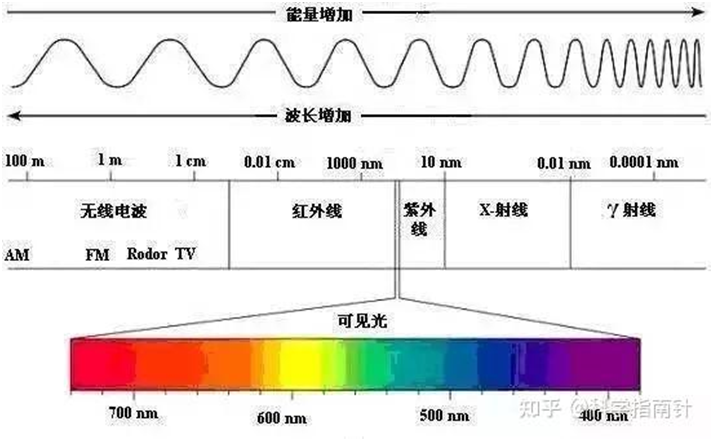
(1) The wavelength range is 0.001~10nm, between ultraviolet and gamma rays on the electromagnetic spectrum, and the X-ray wavelength suitable for diffraction analysis is 0.05~0.25nm.
(2) X-ray penetration is very strong, can penetrate 2~3cm thick wood, 1.5cm aluminum plate, but 1.5cm thick lead plate can completely block X-rays.
(3) X-rays can produce diffraction patterns in crystals, and the analysis of diffraction patterns can determine the crystal structure, which has become the main means to study the structure of matter.
The X-ray tube is not pure monochromatic light, containing a variety of wavelengths of rays, the most important is the K series rays. K ray refers to the cathode electron colliding with the anode, causing the anode electron to produce K excitation, and after striking the K layer electrons, the L or M layer electrons fill the K layer electrons and produce X-rays. K-series rays can be subdivided into two types of rays with slightly different wavelengths: Kα(L-layer electron filling) and Kβ(M-layer electron filling). The X-ray diffractometer requires the use of monochromatic X-rays. Therefore, the latter needs to be removed during XRD testing, and the traditional method is to add a filter (such as Ni) to the optical path. Copper targets are now commonly used, with a graphite crystal monochromator added to the optical path to remove the Kβ rays. The monochromator can remove the diffraction background and also remove the interference of the Kβ rays. The characteristic spectral lines of Cu are: Kα1(1.54056 A), Kα2 (1.54439 A), Kβ1 (1.39222 A). For copper targets, the Kα wavelength is the weighted average of Kα1 and kα2, which is 1.54184 A (λ in Bragg's equation and Scherler's formula).