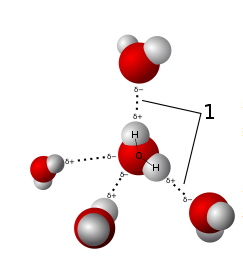





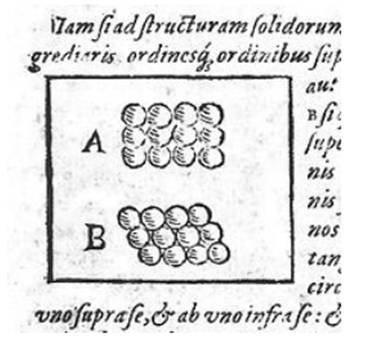
Crystals, although long admired for their regularity and symmetry, were not studied scientifically until the 17th century. Johannes Kepler, in his work The New Year's Gift of Hexagonal Snow (1611), hypothesized that the hexagonal symmetry of snowflake crystalsis due to the regular accumulation of spherical water particles.
The Danish scientist Nicolas Steno (1669) pioneered the experimental study of crystal symmetry. ReneJustHuy (1784) discovered that each face of a crystal can be described in shape and size by a simple stacked pattern of the same blocks. Hauy's work led to the correct view that crystals are regular three-dimensional arrays of atoms and molecules; A single cell repeats indefinitely along three main directions, which are not necessarily vertical. In the 19th century, Johan Hessel, Auguste Bravais, Evgraf Fedorov, ArthurSchonflies, and William Barlow (1894) formulated a complete catalogue of crystal symmetries. Barlow proposed several crystal structures in the 1880s, which were later verified by X-ray crystallography.

X-ray crystallography shows the arrangement of water molecules in the ice, revealing the hydrogen bonds that hold the solid together. There are few other ways to determine the structure of matter with such precision. The photon concept was introduced by Albert Einstein in 1905, but was not widely accepted until 1922, when Arthur Compton confirmed it by scattering x-rays of electrons. Thus, these grainy properties of X-rays, such as their ionization of gases, led William Henry Bragg to argue in 1907 that X-rays were not electromagnetic radiation. However, Bragg's views were not widely accepted, and observations of X-ray diffraction by Max von Laue in 1912 confirmed that most scientists believed X-rays to be a form of electromagnetic radiation.