



Magnetic Skomins are tiny swirls of magnetic spin texture that could in principle be used in spintronic devices, but are currently difficult to control and manipulate at room temperature.
Isolated magnetic Scomingons are topologically protected spin textures that have become the focus of current research due to their potential applications in information technology. Skomingons that occur in ferromagnetic rare-earth transition metal (RE-TM) materials exhibit tunable ferromagnetic properties through antiferromagnetic coupled sublattices.
By selecting rare earth and transition metal elements, they provided a venue for controlling magnetization and vertical magnetic anisotropy, which are key parameters for stable topological ferromagnetic texture.
A class of ferromagnetic alloys with stronger vertical magnetic anisotropy includes compounds of dysprosium (Dy) and cobalt (Co). These materials store information in a more stable manner, but little research has been done to date on their magnetic properties and structures. Now, a research team led by HZB physicist Dr. Florin Radu has analyzed a DyCo3 sample at BESSY II using X-ray microscopy methods and determined its spin structure.
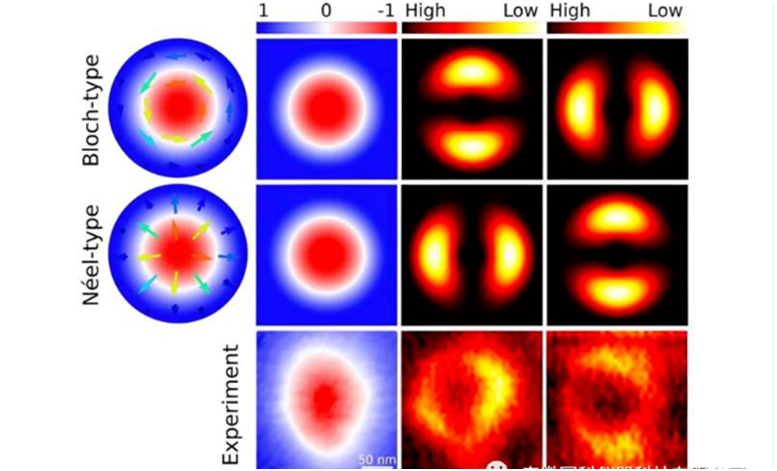
Using scanning transmission X-ray microscopy, they used X-ray magnetic circular dichroism and X-ray magnetic line dichroism as contrast mechanisms for specific elements. The key feature utilized here is that the linear dichroism of RE materials is much stronger than that of TM materials.
The results show that ferromagnetic Skomingons belong to the Neel type and can be clearly distinguished from other domain walls, the Bloch wall. As a result, the type of domain wall can now be reliably determined for the first time using X-ray studies