

一、Information obtained during qualitative analysis by XRD
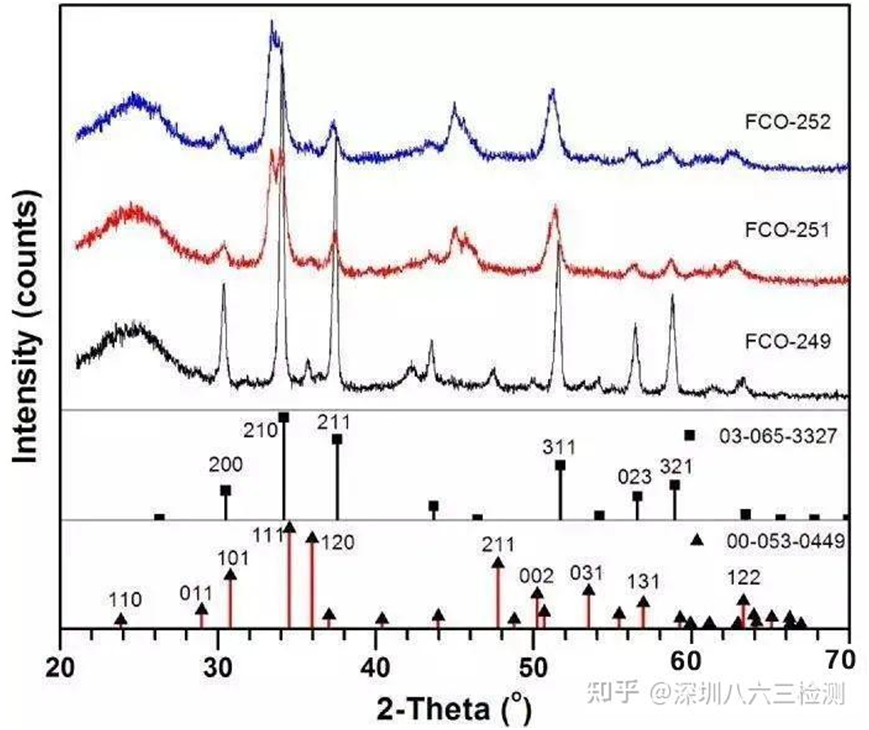
1. According to the XRD pattern information, it can be determined whether the sample is amorphous or crystal: amorphous sample is a large packet peak, no fine spectrum peak structure; Crystals have rich spectral line characteristics. The crystallinity of the sample can be qualitatively known by comparing the strength of the strongest peak in the sample with that of the standard material.
2. By comparing with the standard spectrum, you can know what phase the sample is composed of (one of the most important uses of XRD).
3. Through the difference between the measured sample and the standard spectrum figure 2θ value, the problem of whether the crystal cell expands or contracts can be qualitatively analyzed, because the XRD peak position can determine the size and shape of the crystal cell.
二、What can XRD be used for quantitative analysis?
1. The average grain size of the sample, the basic principle: when the X-ray incident on the small crystal, the diffraction line will become diffuse and wider, the smaller the crystal grain, the wider the X-ray diffraction band. Therefore, there is a certain relationship between the grain size and the half-peak width of the XRD pattern, that is, the Scherrerequation. For the metal particles on the surface of the supported catalyst, the particle size d (unit nm) and its dispersion D can be simply converted: d ≈ 0.9/D (note: 0.9 this constant is an empirical value).
2. Relative crystallinity of the sample: Generally, the area (As) obtained by the integration of the strongest diffraction peak is used As an index to calculate crystallinity, and the area (Ag) obtained by the integration of the standard material is compared, crystallinity =As/Ag*100%.
3. Quantitative analysis of phase content: There are mainly K value method, also called RIR method, and Rietveld full spectrum precision quantification. Among them, the basic principle of the RIR method is that a 1:1 mixture of a substance and corundum (Al2O3), its strongest diffraction peak integral strength will have a ratio, the ratio is the RIR value. The integral strength /RIR value of the substance can always be converted to the integral strength of Al2O3. For a mixture, all the components of the substance are converted in this way, and finally the percentage content of a particular component can be obtained by normalization.
4.XRD can also be used for precise calculation of lattice constant, residual stress calculation, etc