

1.How to strictly distinguish the structure of amorphous, quasicrystals and crystals in XRD pattern?
Answer:There is no strictly defined division between the three. On the XRD pattern obtained by the diffractometer, the pattern is characterized by several or more narrow "spikes" that are generally independent of each other. If these "peaks" are significantly wider, it can be determined that the particle size of the crystals in the sample will be less than 300nm, which can be called "microcrystals".
The characteristic of the amorphous diffraction pattern is that only a gentle change in the intensity of the scattered X-rays is observed in the whole scanning Angle range, which may have one to several maximum values; At the beginning, because the intensity of the beam is close to the direct beam, the intensity decreases rapidly with the increase of the Angle, and the intensity of the high Angle slowly tends to the background value of the instrument.
The "amorphous" transition between these two types is the "quasicrystalline" state.
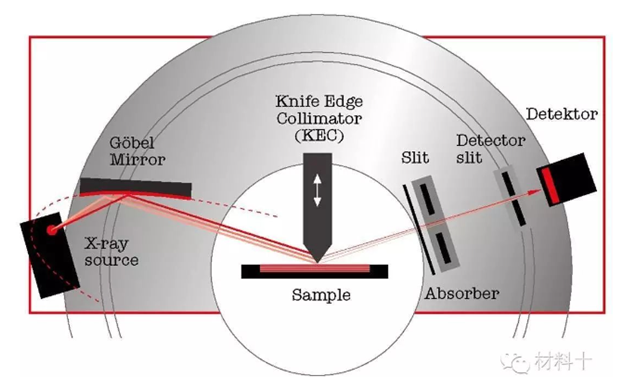
2.When doing X-ray diffraction, if you use different targets, such as copper target or Cr target, will the spectra of the two be the same?
Answer:Different targets have different characteristic wavelengths. The diffraction Angle depends on the wavelength used in the experiment. According to the Bragg equation, the diffraction angles of a certain group of crystal faces with spacing d will be different, and the diffraction angles of each group of crystal faces with spacing values will show regular changes.
Therefore, the position of the diffraction peak on the diffraction pattern obtained by X-ray tubes with different targets is not the same, and the change of the position of the diffraction peak is regular. A crystal has its own set of d values that are inherent in its structure and can be used as a characteristic parameter of the crystal substance.