


X-ray Absorption Spectroscopy (XAS): A Complete Guide to Fundamentals and Experimental Methods
2026-01-12 09:29X-ray Absorption Spectroscopy (XAS) is a sophisticated analytical technique based on synchrotron radiation. By measuring a material's absorption characteristics of X-rays, it reveals crucial information about the local electronic states and geometric structure of atoms. Its core principles can be understood through two dimensions: physical processes and energy regions.
I. Physical Process: Electronic Transitions and Scattering Interference
When the energy of the incident X-rays reaches the ionization energy of an atom's inner-shell electrons (e.g., K or L shell), these electrons are excited as photoelectrons, creating a sharp rise in absorption at the absorption edge. The photoelectron propagates outward as a wave. If it encounters neighboring atoms, elastic scattering (backscattering) occurs. The scattered wave interferes with the outgoing wave at the absorbing atom, causing periodic oscillations in the absorption coefficient as a function of energy. This process is quantitatively described by the Lambert-Beer Law: μ(E) = ln(I₀/I) / d, where μ(E) is the absorption coefficient, d is the sample thickness, I₀ is the incident intensity, and I is the transmitted intensity.
II. Energy Regions: Synergistic Analysis via XANES and EXAFS
X-ray Absorption Near Edge Structure (XANES)
This region focuses on the strong oscillations from about 10 eV below to 50 eV above the absorption edge. It reflects multiple scattering effects of the photoelectron with neighboring atoms. Spectral features (e.g., pre-edge peaks, shoulder peaks) are directly linked to the density of unoccupied electronic states of the absorbing atom. For example, shifts in the absorption edge position allow for quantitative analysis of changes in element oxidation states (e.g., distinguishing Fe²⁺ from Fe³⁺), while the presence of pre-edge peaks reveals information about unoccupied molecular orbitals.
Extended X-ray Absorption Fine Structure (EXAFS)
This region covers the weak oscillations from about 50 eV to 1000 eV above the absorption edge, originating from single scattering events of the photoelectron. Fourier transformation of the oscillatory signal converts it into a radial distribution function, providing precise information such as bond lengths (with accuracy up to 0.01 Å), coordination numbers, and disorder. For instance, in lithium-ion battery research, EXAFS can reveal the evolution of the coordination environment of transition metals (e.g., Ni, Co) during charge/discharge cycles.
III. Experimental Modes: Multi-Mode Adaptation and In Situ Characterization
Transmission Mode
Suitable for high-concentration samples (e.g., powders, thin films). It calculates the absorption coefficient by measuring the intensity ratio of incident to transmitted X-rays. Sample thickness must be controlled to avoid self-absorption effects. Commonly used for static analysis of crystalline, amorphous, and liquid samples.
Fluorescence Mode
Utilizes the intensity of fluorescent X-rays emitted by the target atom after excitation to deduce absorption, making it ideal for low-concentration systems or single-atom studies (e.g., active sites on catalyst surfaces). For example, in studies of Pt catalysts for fuel cells, fluorescence mode can accurately determine the coordination state of surface Pt atoms.
In Situ / Operando Techniques
Combined with controlled environments (high pressure, temperature, electrochemical cells), these techniques enable real-time tracking of dynamic structural changes during reactions. For instance, in electrocatalytic CO₂ reduction studies, operando XAS can unveil the oxidation state changes and coordination reconstruction mechanisms of catalyst active sites.
IV. Technical Advantages and Typical Applications
XAS imposes minimal requirements on sample form (powders, liquids, and gases are all suitable) and is non-destructive. It finds wide application in materials science, energy storage, and environmental monitoring. Examples include: resolving local structural distortions and electronic state distribution in rare-earth-doped semiconductors; characterizing the coordination environment of metal ions in metalloproteins (e.g., heme) for biomedical research and drug design.
By synergistically analyzing XANES and EXAFS data, combined with transmission, fluorescence, and in situ experimental modes, XAS has become a pivotal tool for unveiling the structure-property relationships of materials at the atomic scale, driving advancements from fundamental research to industrial applications.
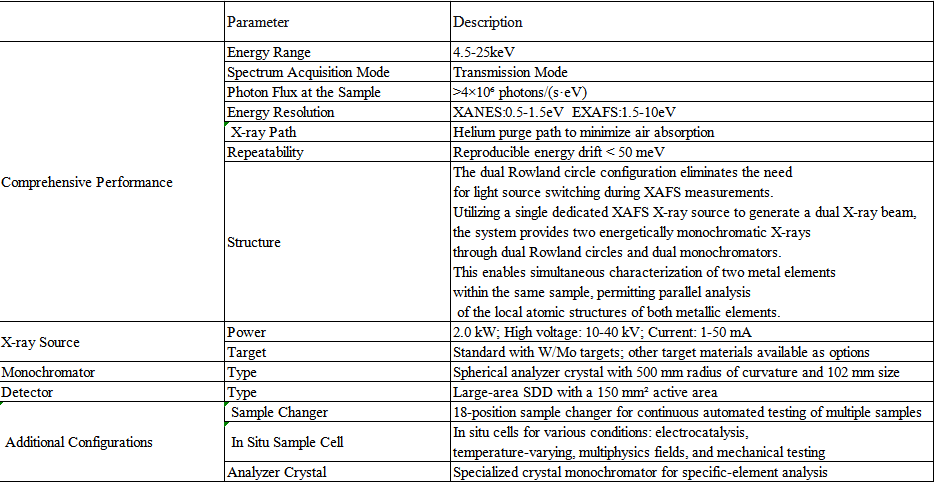
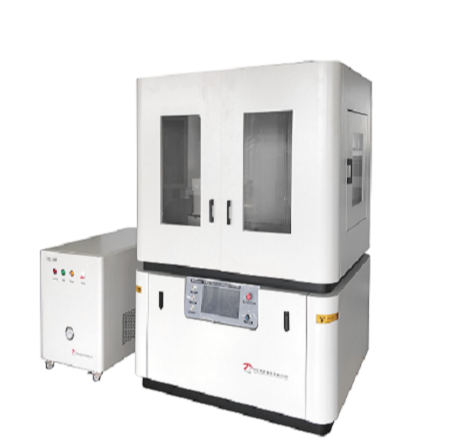
Dandong Tongda Science & Technology Co., Ltd. offers the Absorption Spectrometer. Below are the product specifications. If you would like to discover more about this product or our other X-ray diffractometers and accessories, please feel free to contact us!