



In-depth Derivation of Diffraction Geometry and the Stress-Strain Relationship
2026-01-06 10:00The core of X-ray stress measurement technology lies in determining macroscopic stress by precisely measuring changes in interplanar spacing. Its physical foundation is deeply rooted in the combination of Bragg's law and elastic mechanics theory.
I. The Cornerstone of Diffraction Geometry: Bragg's Law
The premise of this technology is Bragg's Law: nλ = 2d sinθ. Here, λ is the known X-ray wavelength, θ is the diffraction angle, and d is the spacing of specific crystal planes (hkl). In a stress-free state, the material has a specific interplanar spacing d₀ and corresponding diffraction angle θ₀. When stress exists within the material, the lattice undergoes elastic strain, causing d to change (to dψ), which in turn shifts the diffraction angle to θψ. By measuring the change in θψ, we can precisely calculate the relative change in interplanar spacing, i.e., the strain:
εψ = (dψ - d₀) / d₀ ≈ -cot θ₀ · (θψ - θ₀)
II. In-Depth Derivation of the Stress-Strain Relationship: From Lattice to Macroscopic
The measurement above yields the lattice strain εψ in a specific direction (at an angle ψ to the sample surface normal). To relate this to macroscopic stress, we employ the theory of elasticity.
Assumptions & Model: The material is typically assumed to be a continuous, isotropic polycrystal under a state of plane stress (σ₃₃=0). In this case, according to the generalized Hooke's Law, the relationship between the strain εψ in any direction and the principal stresses (σ₁₁, σ₂₂) in the sample coordinate system can be derived.
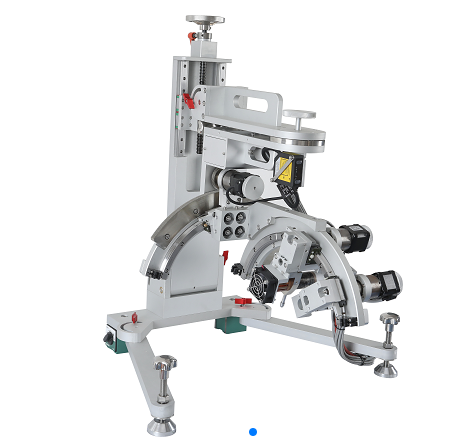
The Key Formula: The sin²ψ Method:
The derivation establishes a relationship between the measured directional strain εψ and components of the stress tensor. For a given angle ψ between the crystal plane normal and the sample surface normal, this relationship can be simplified to:
εψ = [(1+ν)/E] σφ sin²ψ - [ν/E] (σ₁₁ + σ₂₂)
Where E is Young's modulus, ν is Poisson's ratio, and σφ is the stress on the sample surface in a direction at an angle φ to the rotation axis of the goniometer (σφ = σ₁₁ cos²φ + σ₂₂ sin²φ + τ₁₂ sin2φ).
Stress Calculation:
This formula shows that for a fixed φ direction, εψ has a linear relationship with sin²ψ. By measuring a series of diffraction angles θψ at different ψ angles, calculating the corresponding εψ, and performing a linear fit against sin²ψ, the slope M of the fitted line is:
M = [(1+ν)/E] σφ
Consequently, the actual stress in that direction can be calculated:
σφ = [E/(1+ν)] · M
Thus, we complete the full in-depth derivation from microscopic diffraction geometry to macroscopic stress calculation, laying a solid theoretical foundation for the quantitative analysis performed by X-ray stress measurement instruments.