

The most widely used design for high voltage batteries is the diamond anvil unit. Today, Dacs come in a variety of shapes and sizes and can be easily adjusted to different experimental techniques such as spectroscopic (IR, fluorescence, Raman), X-ray, magnetic, or electrical measurements [62]. The most popular version of this compact device (about 4.0 × 3.2 × 1.9 cm), produces pressures of up to 10 GPa and can be integrated effortlessly into a standard diffractometer setup. The basic components of a DAC are shown in Figure 3. The diamonds used in Dacs are typically gem-grade single crystals with a carat weight between 1/8 and 1. They are cut and polished along certain crystal planes for a bright brilliance. The tip base is usually flat, but other designs such as beveled and toroidal coils are also available. [63,64] In order for the crystal to be restrained by a high-voltage diamond battery, it is placed in a sample chamber where a hole is drilled in a metal washer between the diamond anvil. Pressure is applied to the support plate by tightening the screw, which is transferred to the small crystal through the anvil and static pressure medium. In modern Dacs, depending on the application, the support is mainly made of steel, tungsten, titanium, or metal alloys.
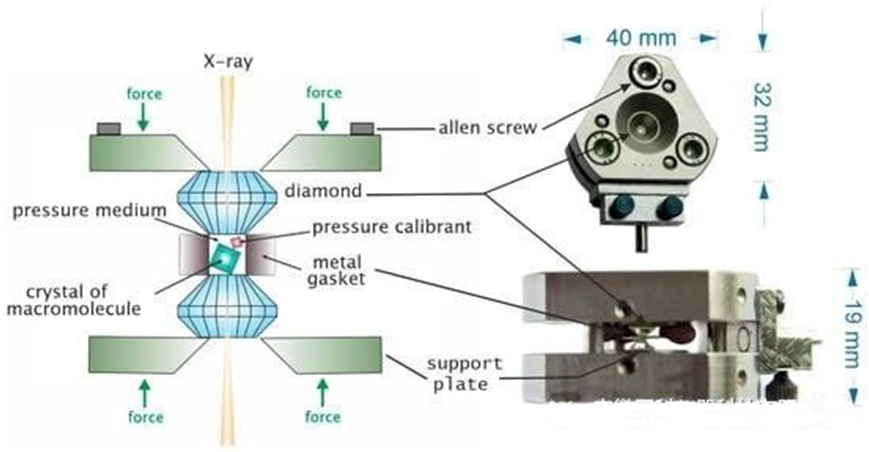
The pressure inside a DAC is usually measured by placing a small piece of calibrator (such as a ruby) in the chamber and measuring the pressure-dependent shift of its fluorescent band. Despite the relatively simple structure of Dacs, their use in bicrystallographic research requires overcoming several hurdles. First, it is important to mention that there is no one-size-fits-all strategy for measuring all macromolecular crystals; However, a general workflow for an HPMX experiment can be determined (Figure 4).
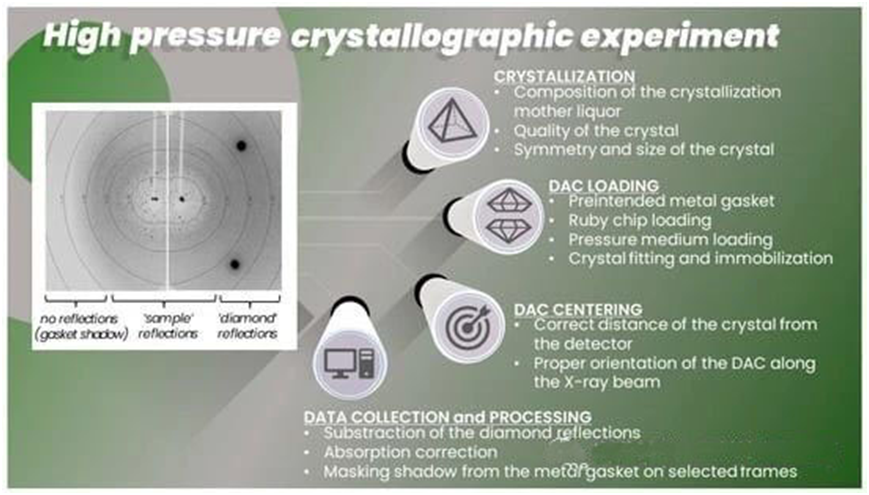
In addition, from an experimental point of view, there are many factors to consider when planning HPMX measurements. The first challenge, especially at low pressure and single crystal measurements, is to prevent crystal movement. Since the DAC is rotating during the measurement, it is important to fix the crystal before data collection. This can be achieved by adding a high concentration (20-30%) of MPD or PEG[66] to the mother liquor, or by placing a low absorptive material within the DAC. The crystal space group and its orientation within the cell are also critical to the success of the measurement. Another factor that significantly affects the HPMX results is the pressure medium. Although crystalline mother liquor is natural selection, two effects can occur during sample loading.
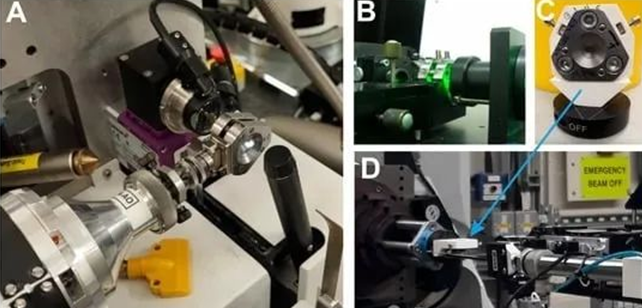
Although HPMX experiments can be easily performed by using Dacs and internal diffractometers, the synchrotron center significantly facilitates HPMX by enabling tunable wavelengths and the tunable size of the beam. There are many synchrotron beamlines that allow DAC installation, but only a few are suitable for high pressure measurements of biological samples. The main limitation is the weight of the DAC battery. The standard diffractometerand other positioning units are equipped with very precise motors to adjust the sample position. This kind of motor is not designed to handle heavy loads. Another difficulty is the space available in the sample environment. The DAC, even in its smallest version, is much larger than the sample holder used for routine crystallography experiments. However, some beamlines overcome this by installing a modular diffractometer [72] or removing attachments around the sample. The DAC can be mounted on a standard goniometer head or a specially developed fixture (Figure 5).
The availability of a new generation of synchrotron sources allows for changes in experimental methods by allowing for different data collection strategies. Using a smaller beam, data can be collected from multiple crystals loaded into the DAC at the same time.