



- Home
- >
News

XAS reveals atomic and electronic structures by measuring element-specific X-ray absorption. It provides key info on valence states and local coordination. Widely used in materials, environmental, and biological sciences. With advanced synchrotron techniques, it enables in-situ studies and dynamic tracking, driving future scientific innovation.
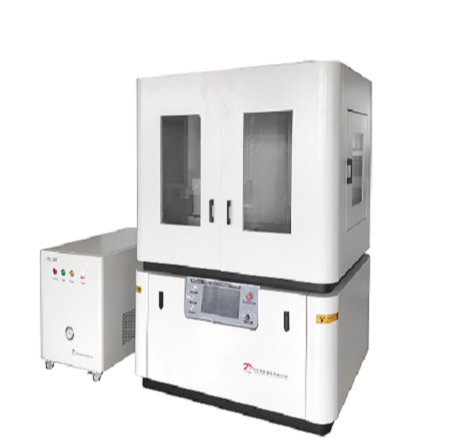
High-Resolution X-ray Absorption Spectroscopy is a cutting-edge technique for atomic-scale analysis of materials' electronic and chemical states. The core challenge is achieving <1 eV energy resolution with high signal-to-noise. We overcome this by combining high-harmonic rejection mirrors with channel-cut monochromators for optimal brightness and resolution, integrating ultra-low-noise silicon drift detectors with real-time calibration for stability, and offering modular in-situ chambers for fast, efficient measurements under realistic conditions. Our spectrometers enable groundbreaking research in catalysis, quantum materials, and biochemistry.
X-ray absorption spectroscopy (XAS) provides atomic-level insights into energy materials. It tracks real-time valence and structural changes in lithium-ion battery electrodes during cycling. For fuel cell catalysts, XAS reveals active sites and stability mechanisms by analyzing electronic states and coordination environments. In photocatalysts, it elucidates charge transfer pathways and dynamic site evolution, guiding the design of advanced materials.
This guide details XAS experiment design, emphasizing uniform sample preparation (e.g., grinding, dilution, inert handling) and precise measurement control (e.g., scan ranges, beam parameters, data averaging). Proper execution ensures reliable data on local atomic structure, vital for catalysis and energy materials research.
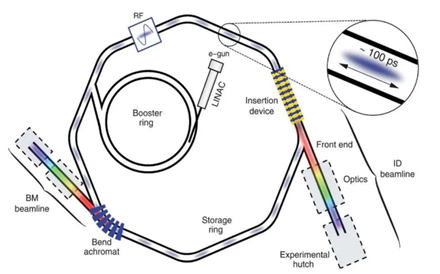
Synchrotron radiation is the electromagnetic radiation produced along the tangent direction of the orbit when the electron is moving in high-speed curve, which can be used to carry out many advanced scientific and technological research.