



X-Ray Stress Analyzer: Working Principle, Structure, and Key Technologies
2026-03-04 08:54The X-Ray Stress Analyzer is a precision instrument that utilizes X-ray diffraction technology to non-destructively measure residual stress on the surface of materials. It is widely used in fields such as mechanical manufacturing, aerospace, rail transportation, and materials research. Residual stress directly affects the fatigue strength and corrosion resistance of components, and the X-Ray Stress Analyzer has become an essential tool in this field due to its non-destructive nature and high accuracy.
I. Working Principle
The theoretical foundation of X-ray stress measurement is based on the phenomena of X-ray diffraction and the principles of elasticity.
When a beam of characteristic X-rays irradiates the surface of a polycrystalline material, diffraction occurs according to Bragg's Law. Stress within the material causes changes in the crystal lattice spacing: tensile stress increases the spacing, while compressive stress decreases it. This lattice strain corresponds precisely to a shift in the diffraction angle (2θ).
The analyzer measures the change in diffraction angle at different incident angles (ψ angles) to calculate the lattice strain in various directions. Based on elasticity theory, by determining the strain in specific directions, the macroscopic residual stress on the material's surface can be derived. In short, the device reflects the macroscopic stress state by measuring minute changes at the lattice scale.
II. Core Structure
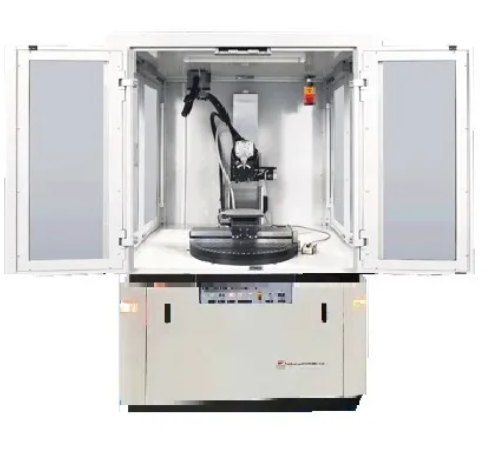
X-Ray Generator: Comprises a high-voltage generator and an X-ray tube (commonly using Cr, Cu, or Co targets). Its function is to produce characteristic X-rays with sufficient intensity and stable wavelength. The stability of the tube voltage and current directly impacts measurement accuracy.
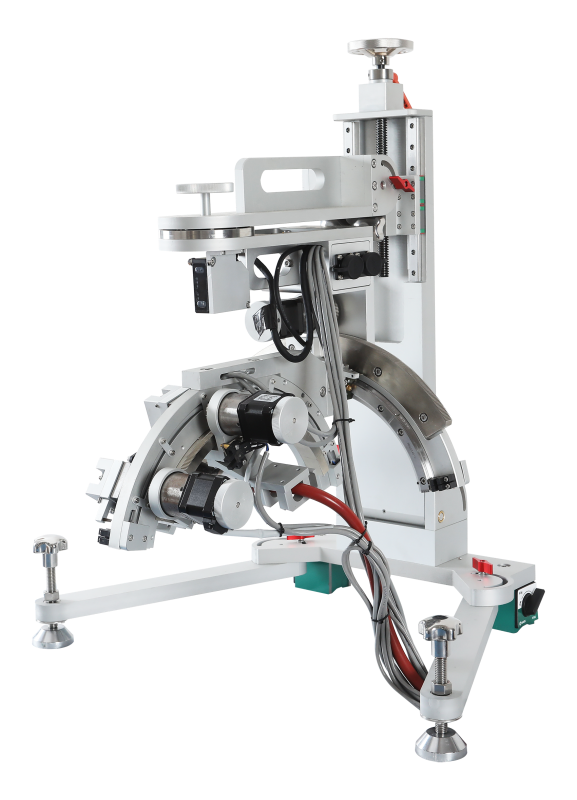
Goniometer: This is the mechanical core and one of the most precise components of the instrument. It uses precision mechanical or servo mechanisms to drive the X-ray tube and detector in a specific geometric relationship, accurately changing the incident beam angle (ψ angle). Modern goniometers require angular control precision at the level of 0.001°.
Detector System: Responsible for receiving and recording diffraction signals at different angles. Traditional equipment uses proportional counters or scintillation counters, scanning to receive the diffraction peak. Modern equipment often uses Position-Sensitive Detectors (PSD) or two-dimensional area detectors, which can simultaneously receive diffraction signals within a certain angular range without moving, significantly improving testing efficiency.
Control System and Software: Integrates motor drive, data acquisition, and stress calculation functions. Specialized software handles diffraction peak determination (using methods like cross-correlation or full width at half maximum), background subtraction, and automatically calculates the final stress value and error based on the sin²ψ method.
III. Key Technologies
Peak Determination Accuracy: Accurately locating the peak position within a broadened diffraction peak is critical for precision. Advanced algorithms (such as the centroid method and parabolic fitting method) effectively reduce errors caused by statistical fluctuations.
Texture and Coarse Grain Handling: To address issues of uneven diffraction intensity caused by material texture or large grains, the equipment needs oscillation or vibration functions. This increases the number of grains participating in diffraction, yielding statistically significant data.
3D Stress Analysis: In addition to surface stress, some equipment, combined with methods like electrolytic polishing, can perform layer-by-layer measurements to analyze the deep stress gradient within the material.

In summary, the X-Ray Stress Analyzer, through precise hardware control and advanced algorithms, transforms atomic-scale lattice changes into critical engineering stress data, providing strong support for material performance and structural safety.