



The Principle of X-ray Diffractometer
2025-12-17 10:24The macroscopic properties of a substance are fundamentally determined by its microscopic crystal structure. X-ray diffraction (XRD) technology serves as the essential “scientific eye” for unveiling this underlying mystery. Its core principle is Bragg’s Law: when a monochromatic X-ray beam strikes a crystalline material, diffraction occurs at specific angles, generating a unique diffraction pattern that acts like a material’s “fingerprint.” This pattern is the key to deciphering a material’s phase composition, crystal structure, stress state, and even grain size.

Fundamental Principle: X-ray Diffraction by Crystals
X-rays are electromagnetic waves with very short wavelengths (approximately 0.01-10 nm), comparable to the distance between atoms in a crystal lattice (on the Ångström scale). When a monochromatic X-ray beam irradiates a crystal with a regular atomic arrangement, the electrons of each atom oscillate and become secondary sources of scattered X-rays. While these scattered waves mostly cancel out, they constructively interfere—or diffract—only in specific directions where the path difference between waves equals an integer multiple of the wavelength. This phenomenon, first demonstrated by Laue in 1912, provides direct evidence of periodic crystal structure.

The Core Equation: Bragg’s Law
Sir W. H. Bragg and W. L. Bragg provided a simplified, powerful model by treating diffraction as “reflection” from parallel atomic planes within the crystal. Diffraction occurs only when the following condition is met:
2d sinθ = nλ
d is the interplanar spacing, a fixed parameter of the crystal.
θ is the angle between the incident X-ray beam and the crystal plane (Bragg angle).
λ is the wavelength of the incident X-ray.
n is a positive integer (the order of diffraction).
This elegant equation directly links the measurable diffraction angle (θ) to the atomic-scale interplanar spacing (d), forming the quantitative foundation for all XRD analysis.
Versatile Workhorse: The TD-3500 X-ray Diffractometer
The TD-3500 is a high-performance, general-purpose powder diffractometer renowned for its exceptional stability and precision, making it an ideal choice for universities, research institutes, and industrial quality control.
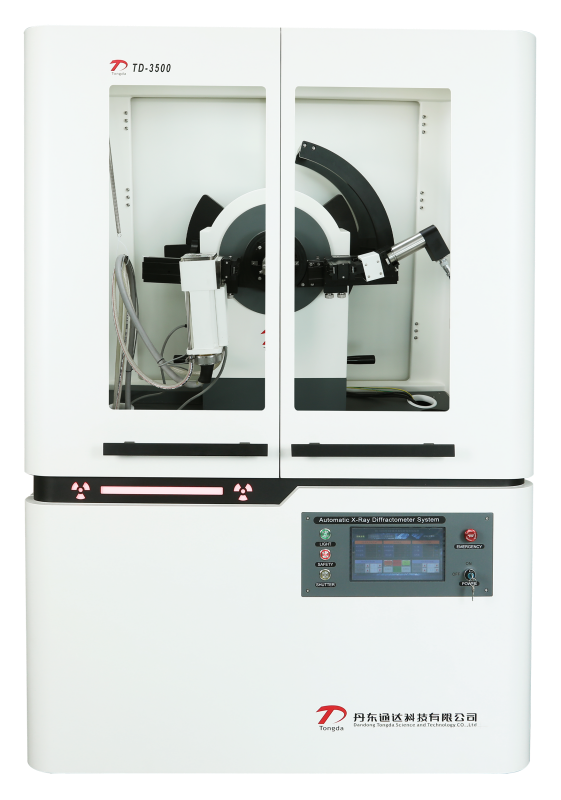
Unmatched Precision:
Its goniometer system, built with imported high-precision bearings and a full-closed-loop servo drive, achieves a minimum step angle of 0.0001° and a 2θ repeatability of ≤0.0005°, ensuring the accurate data required for reliable analysis.
Robust & Reliable:
The system utilizes an imported Siemens PLC (Programmable Logic Controller) for motion control, offering superior stability and lower failure rates compared to traditional designs, guaranteeing long-term, trouble-free operation.
Wide Application Range:
The vertical sample-horizontal (θ-θ) goniometer design facilitates the analysis of diverse sample types—including liquids, pastes, powders, and bulk solids—with minimal risk of contaminating the instrument’s core components.
Cutting-Edge Research Solution: The TD-3700 High-Resolution X-ray Diffractometer
Engineered for advanced research and high-end characterization, the TD-3700 delivers superior performance for the most demanding applications.
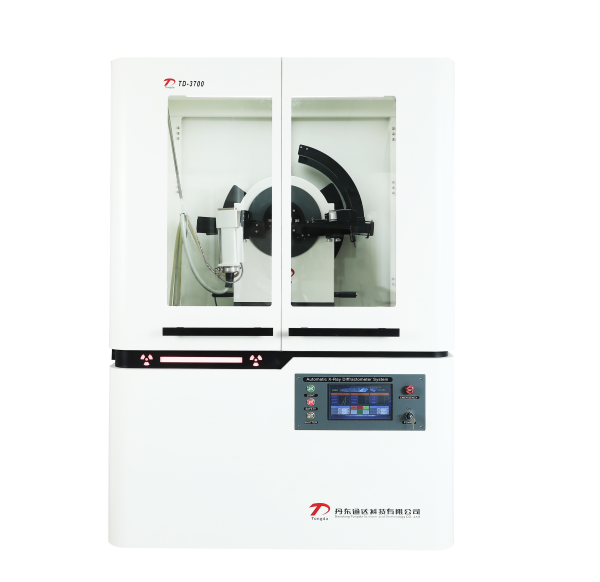
High-Speed Data Acquisition:
It features a standard high-performance one-dimensional array detector, which can accelerate data collection by tens to hundreds of times compared to conventional point detectors, dramatically boosting research productivity.
Dual-Measurement Modes:
Beyond standard reflection geometry, the TD-3700 uniquely supports transmission mode analysis. This mode offers higher resolution for crystal structure studies and requires only minute sample quantities.
Advanced Capabilities:
The platform is designed for seamless integration with various accessories like SDD detectors, in-situ stages (e.g., for battery research or high-temperature studies), and automatic sample changers, enabling everything from high-throughput screening to dynamic in-situ experiments.
Compact Specialist: The TDM-20 Benchtop X-ray Diffractometer
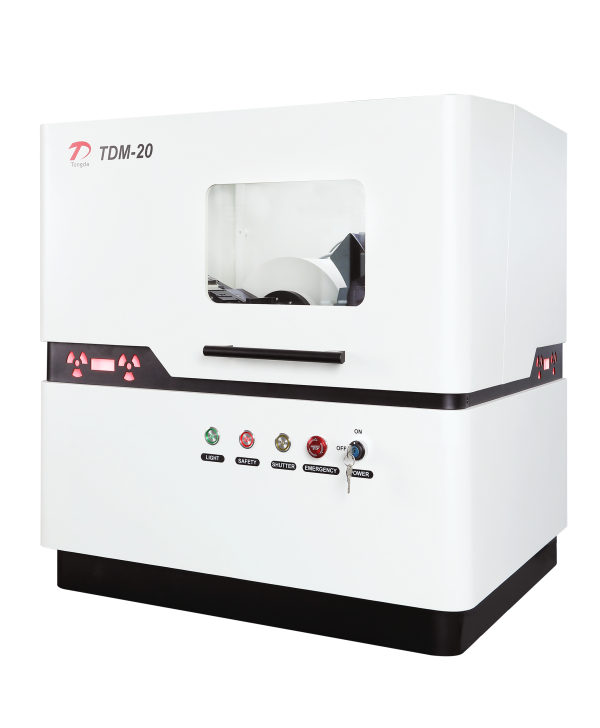
The TDM-20 addresses the need for convenience and efficiency in industrial settings, teaching labs, or facilities with limited space, without compromising on analytical capability.
Integrated & Efficient: This compact benchtop instrument integrates the X-ray tube, generator, goniometer, and detector. With a maximum power of 1200W and a broad 2θ range from -3° to 150°, it performs professional qualitative, quantitative, and grain size analysis.
Smart & Stable: It also employs advanced PLC control technology for intelligent operation and reliable performance, providing a complete, space-saving analytical solution.
From the versatile TD-3500and the advanced TD-3700 to the compact TDM-20, Dandong Tongda Technology Co., Ltd. offers a comprehensive product portfolio that meets diverse needs—from education and routine analysis to cutting-edge research and industrial applications. Each instrument embodies our mastery of core technology and dedication to engineering excellence. We provide not only precision instruments but complete solutions, delivering precise data and deeper insights to support innovation and advancement in materials science worldwide.